From ancient byways to modern highways, glimpses of faith are everywhere...

Wednesday, September 7, 2011

Grandma Moses: Painting from the top down

Reverend Jone Johnson Lewis quotes Grandma Moses as saying this:  I paint from the top down.  From the sky, then the mountains, then the hills, then the houses, then the cattle, and then the people. 

This almost sounds like a theological perspective – one which the young Anna Mary Robertson (“who was born before Abe Lincoln had taken office,” and whose family roots have been traced all the way back to the Mayflower) may have learned from her father, Russell King Robertson.  According to Grandma Moses’ 1961 New York Times obituary, Russell Robertson “was a Methodist, but never went to church, and he allowed his children to believe
what they wanted.  Instead of going to church, they went for long walks in the woods.”

Grandma Moses’ habit of putting people into ecological perspective speaks to a humility that she also practiced in her everyday life.  Rather than putting on airs about becoming a world-famous artist – and rather than deify either herself or her craft - she was able to apply this “paint from the top down” perspective to her own life as well.

Wikipedia reports that she turned to painting – not with dreams of artistic glorification, but for very practical
reasons.  For one thing, it was easier to come up with Christmas and thank-you gifts this way.  For another,
paintings weren’t subject to the ravenous appetites of moths in the way that her embroidery was.  Also, when she began this new endeavor at age 76, it was easier to wield a brush than a needle.

Before then, Anna Mary Robertson Moses had also been a “hired girl” (at age 12), a wife (she afterwards
married the “hired man”), a mother (with “ten children, five of whom died in infancy”), a farm housewife, a
food entrepreneur, and a farm operator (after her husband, Thomas Salmon Moses, died in 1927).

Therefore, she spoke from hard-earned experience when she said this:  I look back on my life like a good day’s work, it was done and I feel satisfied with it…  And life is what we make it, always has been, always will be.

Resources

http://www.nytimes.com/learning/general/onthisday/bday/0907.html
http://womenshistory.about.com/od/quotes/a/grandma_moses.htm
http://en.wikipedia.org/wiki/Grandma_Moses


Copyright September 7, 2011 by Linda Van Slyke   All Rights Reserved


Tuesday, September 6, 2011

Jeff Foxworthy: You might be a Christian if...


The Sermon on the Mount (Bloch, 1890)
The Internet is sprinkled with questions concerning Jeff Foxworthy’s religious beliefs.  The major preoccupation seems to be this:  Is Jeff Foxworthy a Christian?

Foxworthy himself may have already answered that question.  He began a Christian Living Magazine video presentation by declaring the following:  This is what Christian living means to me.  It means that everything, everything, is all about love –
the glory of God.  He went on to explain that, as a youth, he
thought himself not good enough to be a Christian.  It took him a long while to realize that “nobody is” - and that Jesus therefore “paid the price” so that he and others might have an intimate relationship with God.  Foxworthy added that all he wants to do “is to reflect the beauty of such a loving  God” through forgiveness, grace and mercy.  He also feels extremely grateful for his God-given gift of sharing laughter.

Nevertheless, the public remains somewhat confused about Foxworthy’s religious affiliations.  Perhaps this confusion partially stems from a 2008 interview in which Glenn Beck asked about the role that God plays in Foxworthy’s life.  According to a CNN.com transcript, part of Foxworthy’s response was this:  You know what?  I’m not Christian.  I’m – I don’t believe – denomination means to divide.

Although Foxworthy may not believe in denominational Christianity, he certainly does seem to believe in leading a faithful life.  During this same interview, Foxworthy compares human parenting with God’s love.  He states:  …if you understand God you really do understand how to be a parent.  Because you never – you never punish them to hurt them.  You never do it with vengeance.  You never take something away for any – you want to give your kids everything.  The discerning lifestyle that Foxworthy favors – even when show-biz temptations beckon – is one that Christianity, as well as many other religions, could harmonize with.

Resources

http://transcripts.cnn.com/TRANSCRIPTS/0803/21/gb.01.html
http://en.wikipedia.org/wiki/Jeff_Foxworthy
http://www.godtube.com/watch/?v=J22MCFNU
http://en.wikipedia.org/wiki/List_of_Christian_denominations


Copyright September 6, 2011 by Linda Van Slyke   All Rights Reserved

Monday, September 5, 2011

Labor Day: Should hard work be this hard?


(1912 Lawrence textile strike)
Since many spend more waking hours on the job than
anywhere else, the quality of the work experience
becomes exceedingly important.  After all, it doesn’t
matter what color a vocational parachute is if the spirit that is bound to it never gets to soar.  That is why vocational issues are highlighted by a number of religions.

Rabbi Jack Moline calls attention to this quote from
Deuteronomy 24:14:  You shall not abuse a needy and destitute laborer, whether a fellow countryman or a stranger in one of the communities of your land.  He points out that frequent Torah reminders about this dictum stem from the slave-labor experiences of the Israelites in Egypt.
In this sense, the Exodus story can be seen as an intense protest against unfair labor practices.

Mr. Hussam Ayloush quotes Islamic passages about work.  Qur’an 11:85 states the following:  And O my people!  Give just measure and weight, nor withhold from the people the things that are their due.  This next quote is from the Prophet Muhammad (Ibn Majah collection):  Give the employee his wages before his sweat has had time to dry.

Rev. Dr. Matthew Fox’s book, The Reinvention of Work: A New Vision of Livelihood for our Time, goes beyond the notion of “livelihood” as being simply “a means of securing the necessities of life.”  Diane Shirf wrote that “Fox explores the concept of work and how it can be healthier physically, emotionally and intellectually, but primarily socially, environmentally and spiritually.”     

Interfaith Worker Justice (IWJ) and the AFL-CIO feel that Labor Day is an ideal time to reflect upon the plight of workers “who experience low wages, hazardous working conditions, discrimination, unfair treatment on the job, lack of health care benefits, the constant threat of unemployment and plant closure.”  Their “Labor in the Pulpits” program therefore “provides for people of faith and the labor movement to form relationships and to work together” to improve these laborious conditions.

Resources

http://www.aflcio.org/joinaunion/faith/lip.cfm
http://www.jobhuntersbible.com/articles/wciyp.php
http://www.amazon.com/Reinvention-Work-Vision-Livelihood-Time/dp/0060630620
http://www.google.com/#hl=en&q=livelihood&tbs=dfn:1&tbo=u&sa=X&ei=cQdgTufvFarW0QGP7cD_Dw&sqi=2&ved=0CCoQkQ4&bav=on.2,or.r_gc.r_pw.&fp=d8edafa9e328c069&biw=1366&bih=599
http://www.iwj.org/doc/LiMMuslimRef.pdf
http://www.iwj.org/doc/LoBimah2000.pdf
http://en.wikipedia.org/wiki/Lawrence_textile_strike


Copyright September 5, 2011 by Linda Van Slyke   All Rights Reserved 


Sunday, September 4, 2011

Beyond the buns: No hamburger for this cow


(Prithu chasing Prithvi)
Yvonne the Cow must have taken a cue from Taco Bell.  She was decidedly thinking “outside the bun” when she jumped her own personal sinking ship three months ago.

Although some may doubt whether a cow can “think,” that may be because “language based thinkers often have difficulty imagining that animals can think.”  As Temple Grandin (whose autism predisposes her to think in pictures rather than words) has pointed out:  Conscious behavior allows animals to make choices between different options.  She identifies “consciousness” with “the ability of different subsystems within increasingly complex brains to integrate information and make associations.”

Yvonne exhibited numerous “choices between different options” during the three months that she was fleeing
from those who intended to kill her.  NPR reported that Yvonne had been at large since she “dashed to freedom just before she was to be transported to a slaughterhouse in Southern Germany.”  During that time, Yvonne managed to successfully elude all of the following:  search parties of volunteers, hunters who were told to gun her down, helicopters with thermal-imaging cameras, communications from an animal psychic, and the use of other bovines (such as her son, her sister, and a bull ox) as lures.  She hid in the Bavarian forests, and had been spotted eating the corn from farmers’ fields (a habit which ultimately led to her capture).

Even when finally tranquilized into submission, Yvonne did not go down without a fight.  She fought her captors vigorously, not realizing that they were actually her earthly saviors.  The Guardian reports that she, her son, and her sister were purchased by the Gut Aiderbichl animal sanctuary so that they could live out their years in peace and contentment.

This is entirely in keeping with the respect for bovines that is shown by major world religions such as Hinduism, Buddhism, Zoroastrianism, and Jainism.  For example, Prithvi (“Mother Earth”) provides dairy food for Prithu (an incarnation of Vishnu) while in cow (as opposed to hamburger) form.

Resources


http://www.npr.org/blogs/thetwo-way/2011/08/29/140036762/freedom-for-yvonne-germanys-runaway-cow-search-called-off
http://www.guardian.co.uk/world/2011/sep/02/yvonne-cow-caught-three-months
http://www.grandin.com/references/animal.consciousness.html
http://en.wikipedia.org/wiki/Prithvi

Copyright September 4, 2011 by Linda Van Slyke   All Rights Reserved 


Saturday, September 3, 2011

Kitty Carlisle Hart: If it weren't for the Jews


(Heliocentrism)
In a  Jewish Journal article, Tom Teicholz reminisced about a “cabaret-style one-woman show” that he had seen Kitty Carlisle Hart perform when she was 94 years young.

As Hart went through her repertoire of songs by “late friends such as Jerome Kern, George Gershwin, Richard Rodgers…” (all Jews, including Hart herself), Teicholz
couldn’t help but remember this statement that Marlon Brando once made to Jewish talk-show host Larry King:
If it weren’t for the Jews, we wouldn’t have, oddly enough, Broadway and Tin Pan Alley and all the
standards that were written by Jews.  All the songs you love to sing.  Teicholz then goes on to explain that these accomplishments might be traced to the “cantorial tradition” of Judaism.

However, accomplishments of Jews are by no means limited to cantorial compositions.  Lisa Katz reports that “Jews comprise a mere ¼ of 1%... of the world’s population,” yet they have made amazing contributions in the fields of physics (Einstein), psychiatry (Freud), economics (Marx), medicine (Salk), sales (Gimbels), fashion (Levi Strauss), motion pictures (Spielberg), art (Chagall), and poetry (Lazarus) – to name just a few.

Rabbi Pruzansky offers these noteworthy statistics:  From 1900-1950, 14% of the Nobel Prizes in the
sciences or literature were awarded to Jews, but from 1950-2000, an astounding 29%(!) of Nobel Prizes in these fields went to Jews…  He attributes this to the “extraordinarily high value” that Jews have traditionally placed upon learning.  He also points out that certain discoveries that were attributed to others were actually made beforehand by Talmudic scholars.  Among these he lists the telescope, the roundness of the earth, and heliocentrism.   

Hart’s own biography reflects this emphasis upon learning and achievement.  Her German Jewish family
included a former mayor of Shreveport, Louisiana (her grandfather) and a gynecologist (her father).  She herself was educated at the Sorbonne and at the London School of Economics during an era when many women did not graduate from high school.  She then studied acting at London’s Royal Academy of Dramatic Art, and went on to become a film star, an opera singer, and a TV personality.

Resources

http://www.jewishjournal.com/tommywood/article/heart_to_hart_20050701/
http://en.wikipedia.org/wiki/Kitty_Carlisle
http://rabbipruzansky.com/2011/04/01/jewish-accomplishment/
http://judaism.about.com/od/americanjewry/a/accomplishments.htm


Copyright September 3, 2011 by Linda Van Slyke   All Rights Reserved

Friday, September 2, 2011

Paryushan Parva: Forgive us our many trespasses


(Mahavira)
According to ejainism.com, the name “Paryushan Parva” can be defined in a number of ways.  One way combines “Pari” (“all kinds”) with “ushan” (“to burn”) - meaning “to burn (shed) our all types of karma.”  “Ushan” can also mean “to stay closer” - which refers to staying “closer to our own soul.”  Another interpretation is
“Pari” plus “upshamana” – “upshamana” meaning “to suppress” - and combined with “Pari” meaning “to suppress our passions.”

In order to abide by these meanings, Jainism's Paryushan is traditionally honored with spiritual practices rather than with worldly festivities.  During the eight days of Paryushan Parva, laity engage in “penance, Jap (recitation of Mantra) prayer, worship and friendship” to the point of what seems like “temporary monasticism.”  On the final day, Samvastsari Pratikramen, “the annual confession” takes place.  This confession mainly centers
upon forgiveness of all by all.

According to jainuniversity.org, this “pratikramana” confession entails repenting for “the mistake that has been committed and to refrain from it, as also to remain alert that no new mistakes are committed.”  Pratikramen has therefore been compared to a mirror in which “we see our faults and wrongdoings,” then ask “forgiveness for all wrongful acts, and take vows to minimize such acts.”

Pratikramen is meant to be an all-inclusive experience, embracing not only humans, but all sentient beings.  This is reflected within the following Iriyavahi Sutra excerpt:  I desire to free myself from all my sins.  I may have pained living beings while walking on the road.  While coming or going, I may have crushed living beings, seeds, plants, dew, anthills, spider webs, live water, or live earth…  may all such sins be dissolved.      

Resources

http://www.ejainism.com/paryushan.html
http://www.jainuniversity.org/PDFs/Pratikraman.pdf
http://en.wikipedia.org/wiki/Mahavir
http://en.wikipedia.org/wiki/Jainism


Copyright September 2, 2011 by Linda Van Slyke   All Rights Reserved


Thursday, September 1, 2011

Ganesh Chaturthi: Learning to eCoexist


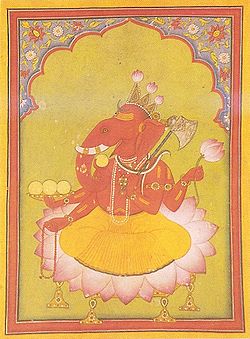
Ganesh (depicted circa 1730)
Ever wonder why Ganesh idols are immersed in water at the conclusion of annual Ganesh Chaturthi festivities?

Thomas Crowley digs deeply into what he calls “the ecological roots of an ancient festival” in order to help answer that question.  He reminds us that “for centuries, Ganesh idols were made of clay.”  He also reminds us that “for millennia, elephants have been worshipped as sacred in India.”  They have often been associated with water (creation), fertility, and with the Mother Goddess (Mother Earth) herself.  According to Crowley, Ganesh “was born” when his Buddhist predecessor “remained a popular god of the people,” and therefore eventually “entered the Brahmin pantheon.”

Wikipedia reports that Ganesh is widely revered by Hindus, Jains, Buddhists, and others.  He is associated with obstacles – often removing them, but sometimes positioning them where needed.  Buddhists consider Ganesh to be “the Lord of letters and learning.”  Hindus believe that he personifies the sacred sound of Aum.  Kundalini yoga teaches that Ganesh “resides in the first chakra” at the base of the spine, and therefore governs “the forces that propel the wheel of life.”

Ganesh has therefore always been intimately connected with the ecological circle of life.  Crowley ties the modern-day immersions of the Ganesh idol to the ancient monsoon celebrations.  He points out that Ganesh Chaturthi occurs “towards the end of the monsoon, which, even today, Indian farmers rely upon as their main source of agricultural water.”

An ecological organization, eCoexist, has been determined to protect this precious water which Mother Earth has so graciously provided.  Rather than pollute the waters with icons made of plaster and paint, eCoexist offers “Green Ganesh” alternatives made from clay, paper mache, and other earth-friendly materials.

Resources

http://en.wikipedia.org/wiki/Ganesh_Chaturthi#cite_note-2
http://en.wikipedia.org/wiki/Ganesha
http://www.e-coexist.com/products/ganesh-chaturthi/resources-on-ecosensitive-ganesh-chaturthi
http://www.realitysandwich.com/ganesh_eco_festival


Copyright September 1, 2011 by Linda Van Slyke   All Rights Reserved